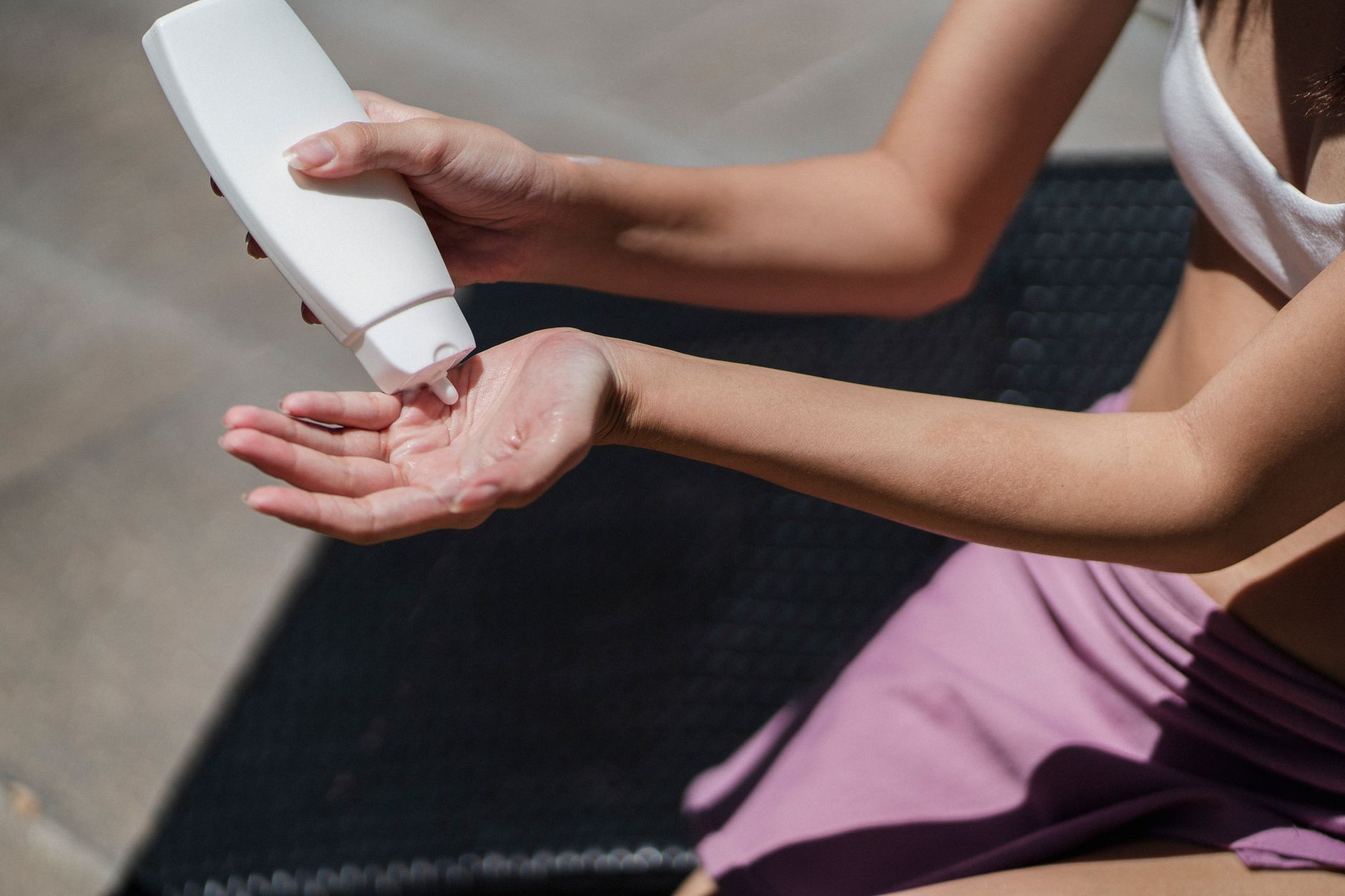
Somewhere between "wear sunscreen" and "never see daylight again," the beauty industry found its golden goose. SPF—once a straightforward recommendation from dermatologists—has morphed into a full-blown anxiety economy, complete with UV-detection stickers, arm-length gloves, and formulas boasting protection factors that would make a hazmat suit blush.
The data is clear: SPF 30 blocks 97% of UVB rays, SPF 50 blocks 98%. Anything higher offers diminishing returns so microscopic they're essentially a rounding error. Yet brands keep launching SPF 100+, influencers reapply every forty-five minutes like it's a religious ritual, and consumers mainline fear about "invisible damage" while Vitamin D deficiency rates climb. We've crossed from prevention into performance art.

SPF Inflation Makes No Mathematical Sense
Brands are launching SPF 70, 90, even 110 formulas, banking on the assumption that higher numbers mean exponentially better protection. They don't. The difference between SPF 50 and SPF 100 is roughly 1% more UVB blocking—a margin so trivial that improper application (which most people are guilty of) negates it entirely. This isn't innovation; it's the beauty equivalent of airport security removing your shoes. It creates the feeling of safety without delivering meaningfully more of it.

The Reapplication Panic Is Out of Control
TikTok dermatologists have convinced a generation that if you're not reapplying SPF every two hours—indoors, under fluorescent lights, nowhere near a window—you're essentially courting melanoma. The reality: unless you're sweating profusely or swimming, your morning application holds up far longer than the fear-mongers suggest. This compulsive reapplication serves brands beautifully (you'll tear through product three times faster) but does very little for your actual skin beyond triggering a Pavlovian anxiety response every time you check your phone.

UV-Blocking Accessories Have Entered Chat
Face masks with SPF 50+ fabric. Fingerless sun gloves for your morning commute. Parasols marketed as "dermatologist-approved UV shields." The sun protection industrial complex has successfully pathologized being outside, transforming normal daylight exposure into something requiring full tactical gear. It's Victorian modesty culture repackaged as wellness, and it's selling remarkably well to people who've been convinced that ambient light is their enemy. Going outside shouldn't require cosplay.

Blue Light Panic Was Just a Warmup Act
Remember when brands convinced you that your laptop was aging you faster than actual sun? That manufactured crisis was the beta test for today's sun paranoia. Studies on blue light damage were extrapolated from conditions no human would ever experience (think: face pressed against a screen for 100 consecutive hours), yet the beauty industry ran with it. Now we're seeing the same playbook with SPF: take a grain of truth, amplify it into existential threat, sell the antidote. The formula works because it's nearly impossible to disprove a negative.

Meanwhile, Vitamin D Deficiency Is Actually Rising
The irony of our collective sun phobia: rates of Vitamin D deficiency are climbing, particularly among young women who've been the primary targets of aggressive SPF marketing. Dermatologists rarely mention that brief, unprotected sun exposure is how your body produces this crucial hormone, because it complicates the narrative. We've created a population so terrified of UV rays that they're supplementing a vitamin their bodies are designed to make naturally. That's not health optimization—that's ideology masquerading as skincare.